

Brand Strategy
The Marketing Clarity Loop
A five-step cyclical framework for building a marketing function that compounds over time.
What it is:
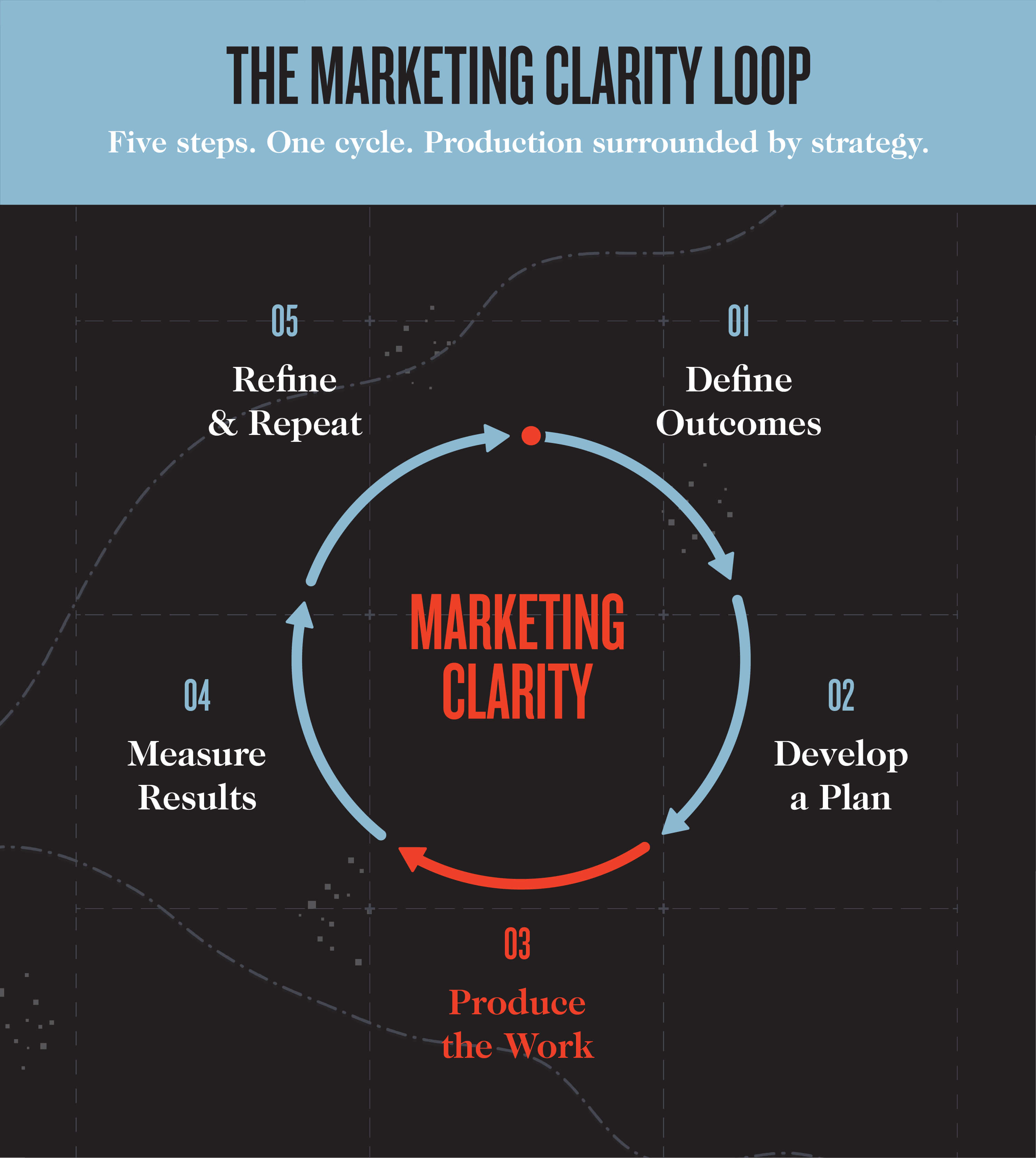
The Marketing Clarity Loop describes the operating logic behind a healthy marketing function. It runs in five steps: Define Outcomes, Develop a Plan, Produce the Work, Measure Results, and Refine and Repeat. Step five feeds back into step one, which is the point. When the loop runs cleanly, marketing builds on itself. When any step is skipped, the function generates activity without direction.
Most organizations experience marketing as a collection of tasks. The loop reframes it as a system with a sequence. Each step depends on the one before it, and the cycle never ends. That design is deliberate: markets change, strategies need to adapt, and what worked last quarter may need adjustment this quarter. The loop creates the rhythm for that ongoing refinement.
The loop was developed in response to a pattern we see consistently across mid-market organizations. Companies invest in marketing, hire capable people, and still find themselves unable to tell whether any of it is working. The usual explanation is a tactical one: wrong channel, wrong message, wrong timing. The actual explanation is usually structural.
The structural problem starts at step three. Most marketing hires are made for production capability: someone who can design, post, manage a calendar, update a page, run ads from a template. Those skills are real and necessary. They belong in the loop at step three. The trouble is that step three, handled well, requires context from steps one and two, and accountability from steps four and five. When a production-capable person carries all five steps without support, the loop collapses into a single, endless task list.
There is also a quality dimension worth naming. Production capability exists on a spectrum. Using a design tool is different from knowing what to design and why. Updating a web page is different from understanding whether the page is doing its job. The loop works best when experienced creative and strategic judgment sits above and alongside whoever is doing the tactical work, shaping the output and maintaining the standard.

The Five Steps
- Define Outcomes: Establish what the business is trying to accomplish through marketing, in business terms. Growth in a specific segment, stronger conversion from existing traffic, positioning ahead of a competitive shift. Outcomes drive every decision downstream.
- Develop a Plan: Choose which tactics and channels to pursue given real constraints. Budget, team capacity, timeline, competitive position. A plan is a filter. Without one, every tactic looks equally reasonable.
- Produce the Work: Execute with craft and consistency. Design, content, campaigns, media, web. This is where the work becomes visible, and where brand standards, creative judgment, and production quality determine whether the strategy lands.
- Measure Results: Evaluate what moved and what did not, against the outcomes defined in step one. Leading indicators and lagging indicators. Honest interpretation, not optimistic framing of activity metrics.
- Refine and Repeat: Feed what was learned back into step one. Adjust the plan. Stop what is underperforming. Start the next cycle with more information than the last one had.
Use it when:
- Assessing why a marketing function feels busy but unproductive
- Onboarding a new marketing hire or agency relationship
- Presenting the marketing planning process to leadership
- Diagnosing where a campaign or program broke down
- Building a marketing plan from scratch
Why it works:
- Gives leadership and marketing teams a shared vocabulary for the function
- Surfaces structural problems before they get diagnosed as creative or channel failures
- Creates a natural accountability structure: each step has an owner and an output
- Works at any scale, from a one-person marketing function to a full department
Not sure where your loop is breaking down?
The Marketing Clarity Check is a free 12-question diagnostic that scores your marketing function across each step of the loop. Five minutes. Instant results.
Want to talk through what it means for your organization?